ArchangelsBooks.com - Printer Friendly Page
© 2004-2007 — ArchangelsBooks.com
ArchangelsBooks.com
A Discourse in Iconography
by St. John of Shanghai and San Francisco
Iconography began on the day our Lord Jesus Christ pressed a
cloth to His face and imprinted His divine-human image thereon.
According to tradition, Luke the Evangelist painted the image
of the Mother of God; and, also according to tradition, there
still exist today many Icons which were painted by him. An artist,
he painted not only the first Icons of the Mother of God, but
also those of the holy Apostles Peter and Paul and, possibly,
others which have not come down to us.
Thus did Iconography begin. Then it came to a halt for a time.
Christianity was cruelly persecuted: all that was reminiscent
of Christ was destroyed and subjected to ridicule. Thus, during
the course of the persecutions, Iconography did not develop, but
Christians attempted to express in symbols what they wished to
convey. Christ was portrayed as the Good Shepherd, and also in
the guise of various personalities from pagan mythology. He was
also depicted in the form of a vine, an image hearkening back
to the Lord's words: "I am the true Vine.... ye are the branches"
(St. John 15:1, 5). It was also accepted practice to depict Christ
in the form of a fish, because if one writes in Greek "Jesus
Christ, Son of God, Savior" (Iesous Christos, Theou
Hios, Zoter) and then groups together the first letter
of each word, one discovers that one has written the Greek word
Ichthys, "fish." And so, Christians depicted
a fish, thereby calling to mind these words which were known to
those who believed in the Savior. This also became known to the
pagans, and consequently the image of the fish was also held suspect.
When, following the victory of Emperor Constantine the Great
over Maxentius, freedom was given to Christians, Christianity
quickly transformed the Roman Empire and replaced paganism. Then
Iconography flourished with full force. We already see directives
concerning Iconography at the first ecumenical councils. In some
church hymns, which today are still frequently used, mention is
also made of Iconography.
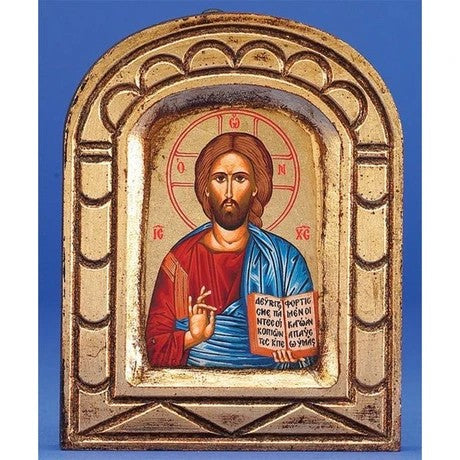
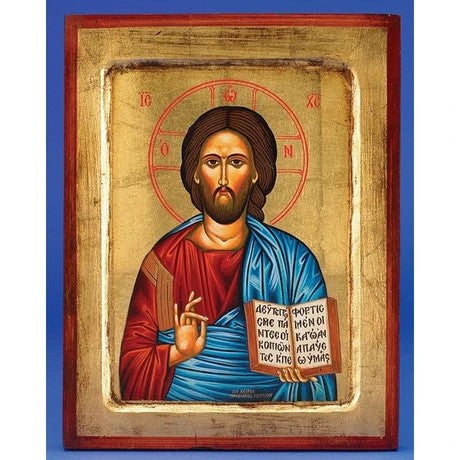
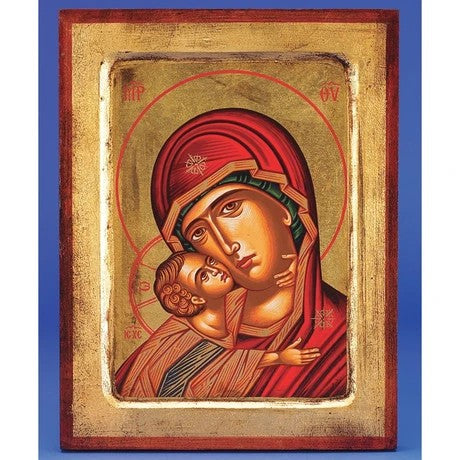
Now what are Icons? Icons are precisely the union between painting
and those symbols and works of art which replaced Icons during
the time of persecution. The Icon is not simply a representation,
a portrait. In later times only has the bodily been represented,
but an Icon is still supposed to remind people of the spiritual
aspect of the person depicted.
Christianity is the inspiration of the world. Christ founded
His Church in order to inspire, to transfigure the world, to cleanse
it from sin and bring it to that state in which it will exist
in the age to come. Christianity was founded upon the earth and
operates upon the earth, but it reaches to Heaven in its structure;
Christianity is that bridge and ladder whereby men ascend from
the earthly Church to the Heavenly. Therefore, a simple representation
which recalls the earthly characteristics of some face is not
an Icon. Even an accurate depiction, in the sense of physical
build, still signifies nothing. A person may be very beautiful
externally, yet at the same time be very evil. On the other hand,
he may be ugly, and at the same time a model of righteousness.
Thus, we see that an Icon must indeed depict that which we see
with our eyes, preserving the characteristics of the body's form,
for in this world the soul acts through the body; yet at the same
time it must point towards the inner, spiritual essence. The task
of the Iconographer is precisely to render, as far as possible
and to as great an extent as possible, those spiritual qualities
whereby the person depicted acquired the Kingdom of Heaven, whereby
he won an imperishable crown from the Lord, for the Church's true
significance is the salvation of man's soul. That which is on
the earth perishes when we bring the body to the grave; but the
soul passes on to another place. When the world comes to an end,
consumed by fire, there will be a new earth and a new Heaven,
as the Apostle John the Theologian says, for with the eyes of
his soul he already foresaw the New Jerusalem, so clearly described
in his sacred Revelation. The Lord came to prepare the whole world
for this spiritual rebirth. To prepare oneself for this new Kingdom,
one must uproot from within oneself those seeds of sin which entered
mankind with our ancestors' fall into sin, distorting our pristine,
grace-endowed nature; and one must plant within oneself those
virtues which they lost in the fall. The Christian's goal is to
change daily, to improve daily, and it is of this that our Icons
speak.
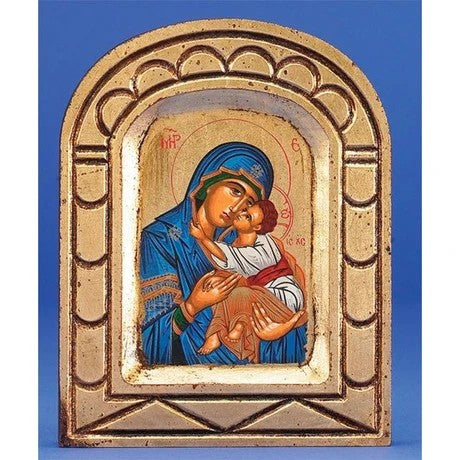
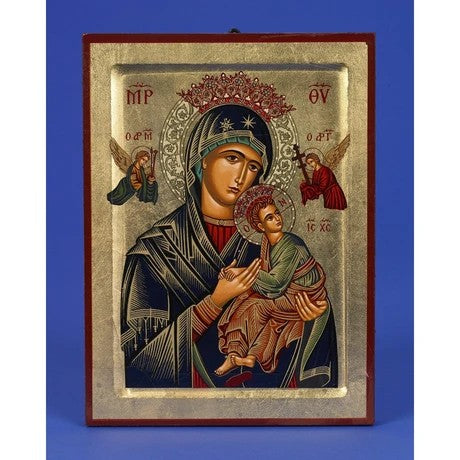
In calling to mind the saints and their struggles, an Icon does
not simply represent the saint as he appeared upon the earth.
No, the Icon depicts his inner spiritual struggle; it portrays
how he attained to that state where he is now considered an angel
on earth, a heavenly man. This is precisely the manner in which
the Mother of God and Jesus Christ are portrayed. Icons should
depict that transcendent sanctity which permeated the saints.
The Lord Jesus Christ is the union of all that is human and all
that is divine; and when depicted in an Icon, the Savior must
be painted so that we sense that He is a man, a real man, yet
at the same time something more exalted than a man, that we not
simply approach Him as we app. roach a visitor or an acquaintance.
No, we should feel that He is One Who is close to us, our Lord
Who is merciful to us, and at the same time an awe-inspiring Judge
Who wants us to follow Him and wishes to lead us to the Kingdom
of Heaven. Therefore, we must not turn away to one side or the
other. We should not depict only the spiritual aspect of the saint,
completely disregarding how he looked while alive on earth. This
would also be an extreme. All saints should be depicted so as
to convey their individual characteristics as much as possible-soldiers
should be portrayed arrayed for battle; holy hierarchs in their
episcopal vestments... It is incorrect to depict bishops of the
first centuries vested in the sakkos, for at that time
bishops wore the phelonion, not the sakkas, and
yet this is not such a great error, for it is far better to make
a mistake in what is physical than in what is spiritual, to ignore,
as it were, the spiritual aspect.
However, it is far worse when everything is correct in the physical,
bodily sense, but the saint appears as an ordinary man, as if
he had been photographed, completely devoid of the spiritual.
When this is the case, the depiction cannot be considered an Icon.
Sometimes much attention is spent on making the Icon beautiful.
If this is not detrimental to the spirituality of the Icon, it
is good, but if the beauty distracts our vision to such an extent
that we forget what is most importantthat one must save
one's soul, must raise one's soul to the heights of Heaven,the
beauty of the depiction is already detrimental. It cannot be considered
an Icon, but merely a painting. It may be very beautiful, but
it is not an Icon. An Icon is an image which leads us to a holy,
God-pleasing person, or raises us up to Heaven, or evokes a feeling
of repentance, of compunction, of prayer, a feeling that one must
bow down before this image. The value of an Icon lies in the fact
that, when we approach it, we want to pray before it with reverence.
If the image elicits this feeling, it is an Icon.
This is what our Iconographers were zealous aboutthose
ancient Iconographers of the time before the conversion of Russia,
of whom there were many, and our Russian Iconographers, too, beginning
with the Venerable Alypius of the Kiev Caves, who painted a number
of Icons of the Mother of God, some of which still survive. These
wondrous Icons, which continued the Byzantine tradition of the
painting of Icons which inspire compunction, were not necessarily
painted in dark colors; frequently they were done in bright hues;
but these colors evoked a desire to pray before such Icons. The
holy hierarch Peter, a native of Galicia who later became Metropolitan
of Kiev and All Russia, painted Icons, some of which were until
recently to be found in the Cathedral of the Dormition in Moscow.
An entire school of Iconography was established in Novgorod under
the direction of the holy hierarch Alexis of Novgorod, a whole
series of whose Icons have been preserved. The Venerable Andrew
Rublev painted an Icon of the Holy Trinity which is now famous
not only in the Christian world, but throughout the half-Christian
world as well.
Unfortunately, this Orthodox movement as a whole started to collapse
when Russia began to be infiltrated by Western influence. In certain
respects, Russia's acquaintance with the European West was very
beneficial. Many technical sciences and much other useful knowledge
came from the West. We know that Christianity has never had any
aversion to knowledge of that which originates outside itself.
Basil the Great, Gregory the Theologian and John Chrysostom studied
in pagan universities, and many writers, among whom were our spiritual
authors and many of the best theologians, were well acquainted
with pagan writers. The Apostle Paul himself cited quotations
from pagan poets even in the Holy Scriptures. Nevertheless, not
all that was Western was good for Russia. It also wrought horrible
moral damage at that time, for the Russians began to accept, along
with useful knowledge, that which was alien to our Orthodox way
of life, to our Orthodox faith. The educated portion of society
soon sundered themselves from the life of the people and from
the Orthodox Church, in which all was regulated by ecclesiastical
norms. Later, alien influence touched Iconography as well. Images
of the Western type began to appear, perhaps beautiful from an
artistic point of view, but completely lacking in sanctity, beautiful
in the sense of earthly beauty, but even scandalous at times,
and devoid of spirituality. Such were not Icons. They were distortions
of Icons, exhibiting a lack of comprehension of what an Icon actually
is.
The purpose of this article is, first of all, to promote an understanding
of the true Icon, and secondly, to cultivate a love for the Icon
and the desire that our churches and our homes be adorned with
genuine Icons and not with Western paintings which tell us nothing
about righteousness or sanctity, but are merely pleasant to look
upon. Of course, there are Icons painted correctly in the Iconographic
sense, but yet very crudely executed. One can paint quite correctly
in the theoretical sense and at the same time quite poorly from
a practical standpoint. This does not mean that, from the principle
of Iconography itself, these Icons are bad. On the other hand,
it happens that one can paint beautifully, yet completely ignore
the rules of Iconography. Both such approaches are harmful. One
must strive to paint Icons well in principle, method and execution.
This is why we oppose certain people and their attempts to paint
our churches, for they have the wrong approach, the wrong point
of view. They may paint well, perhaps; but when the point of view
is incorrect, when the direction is wrong, no matter how well
the locomotive runs, it nonetheless slips off the track and is
derailed. This is precisely what happens to those who execute
their work technically and correctly, yet due to an incorrect
approach and an incorrect point of view, they travel the wrong
path.
From Orthodox Life, Vol. 30, No. 1 (Jan-Feb 1980), pp.
42-45.